Direct Control
The Direct Control interface allows the agents to control the robots directly through the defined perception and control primitives by us (RoboDawn). And this makes it clear that this interface is bottlenecked by the available primitives to the agent and the intelligence of the agent itself.
The implementation for direct control looks like:
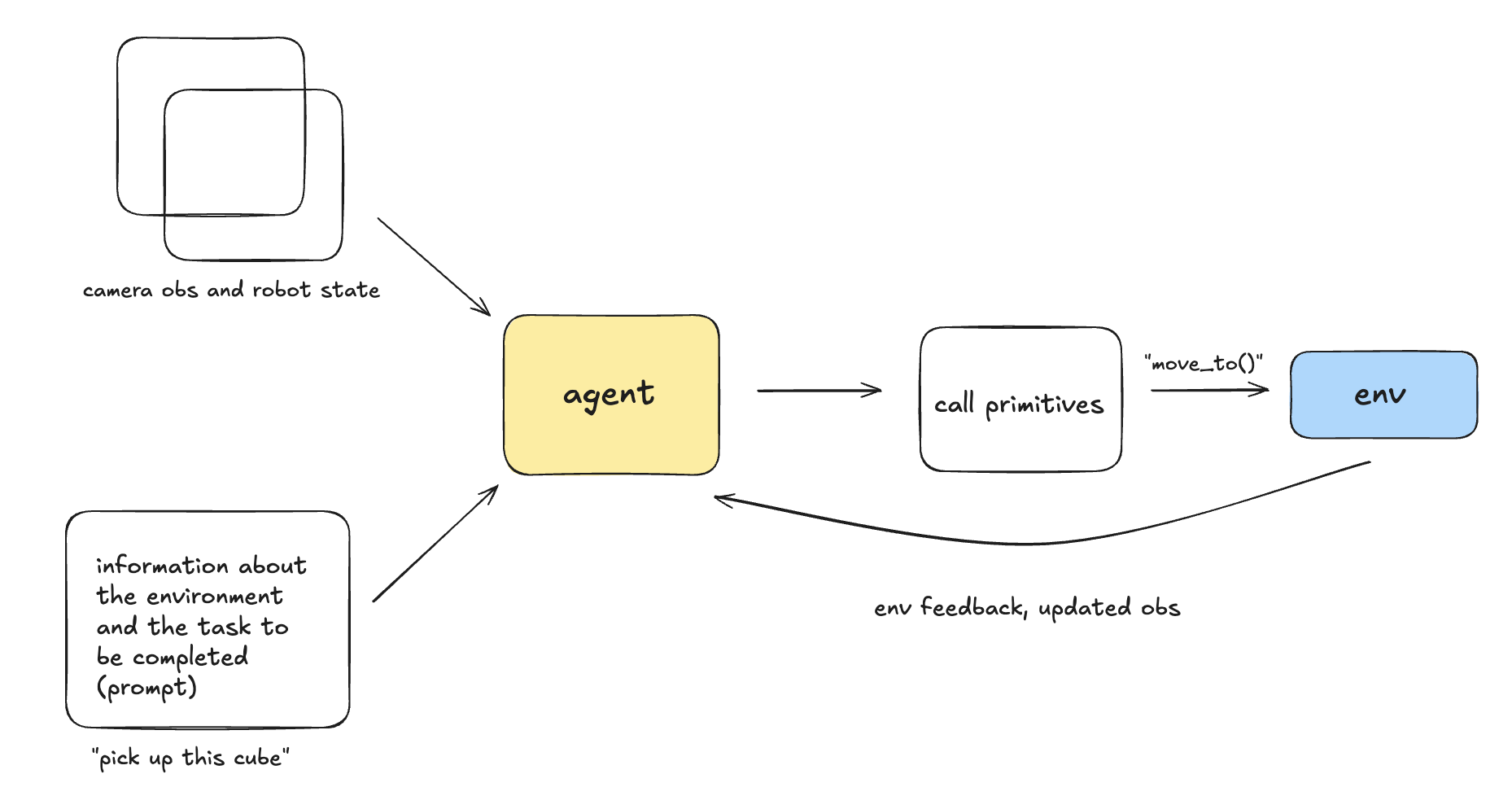
hud-python#778 works towards adding primitives for sensor transforms by giving the agent full pose of the camera, live transform for moving cameras like on wrists and the their intrinsics to let agent estimate the object distance from the robot and in the world. This gave huge gains in the success rate and efficiency as compared to direct control without this information.
Direct Control (Sonnet)
| task | camera poses | success | calls / run | sim time | first-move miss | cost / run |
|---|---|---|---|---|---|---|
| lift a cube | none | 8/10 | 11.2 | 30.0 s | 130 mm | $0.094 |
| lift a cube | yes | 10/10 | 5.0 | 13.2 s | 12 mm | $0.039 |
| pick and place a cube | none | 8/10 | 15.0 | 43.9 s | 37 mm | $0.113 |
| pick and place a cube | yes | 10/10 | 9.5 | 25.7 s | 8 mm | $0.067 |
10 runs per row. first-move miss is how far the agent's first reach landed from the cube.
Direct Control, Live Wrist Pose (Haiku)
| task | camera poses | success | calls / run | first-move miss |
|---|---|---|---|---|
| pick and place 2 cubes | none | 0/5 | 30.2 | 95 mm |
| pick and place 2 cubes | fixed cameras | 3/5 | 27.2 | 57 mm |
| pick and place 2 cubes | fixed + live wrist | 5/5 | 22.6 | 8 mm |
Direct Control differs from Code as Policy as agent in direct control executes one command at a time and takes in feedback, whereas, in CaP it writes the whole sequence at once and executes it and then acts upon it. This might lead to direct control being slower and inefficient than CaP.
Direct Control vs Code as Policy (Sonnet)
| task | Direct Control | Code as Policy | ||||
|---|---|---|---|---|---|---|
| success | calls / run | sim time | success | calls / run | sim time | |
| lift a cube | 5/5 | 5.0 | 13.1 s | 5/5 | 3.0 | 12.3 s |
| pick and place a cube | 5/5 | 8.2 | 21.7 s | 5/5 | 2.6 | 21.9 s |
| pick and place 2 cubes | 4/5 | 16.8 | 49.4 s | 5/5 | 3.2 | 48.8 s |
Policy Supervision
The Policy Supervision interface lets the agent guide the VLA/WAM model by breaking down tasks in subtasks on which the model was trained.
VLAs alone are usually bad at long horizon tasks and to any perturbations in the scene or the prompt (RoboCerebra). A higher level orchestrator/supervisor (System 2) is needed to cover these limitations for it and that is where we put our agent. (Orchestrating Robot Policies, VoLoAgent)
LIBERO
turn on the stove → push the plate to the front of the stove → put the bowl on the plate → put the cream cheese in the bowl → put the wine bottle on the rack.
| policy | start layout | policy alone | sonnet supervising | opus supervising |
|---|---|---|---|---|
| smolvla | 1 | 0/5 | 1.3/5 | 1/5 |
| smolvla | 2 | 0/5 | 2/5 | 3/5 |
| pi0.5 | 1 | 2/5 | 2/5 | 4/5 |
The agent acts as the orchestrator and breaks down the task into subtasks. While the low level model is working on the given task, the agent still supervises it and looks out for any failure. If any, the agent takes over the control of the robot. Now, I've noticed there are several conditions on which researchers have arrived for as to when should the agent be invoked and take over the robot. One is to invoke it every few seconds (Hi Robot, Orchestrating Robot Policies) or is to set expected execution time for a task (Orchestrating Robot Policies).
Policy Alone vs Supervised
| task | policy | policy alone | sonnet supervising | opus supervising |
|---|---|---|---|---|
| lift a cube | smolvla, fine-tuned on this scene | 1/3 | 2/3 | 3/3 |
| pick and place a cube | smolvla, fine-tuned on this scene | 0/3 | 3/3 | 3/3 |
In this interface, the supervisor decides if the task has been completed or not and it can be a bit challenging to conclude that a task has been completed from ~2 medium quality images from sim. That's why, a grounding agent is used that uses Grounding DINO or SAM3 to detect objects, which agent can use to guide the VLA or to take any further decision. (VoLoAgent, FIT-MAC)
My implementation for the Policy Supervision interface is something like:
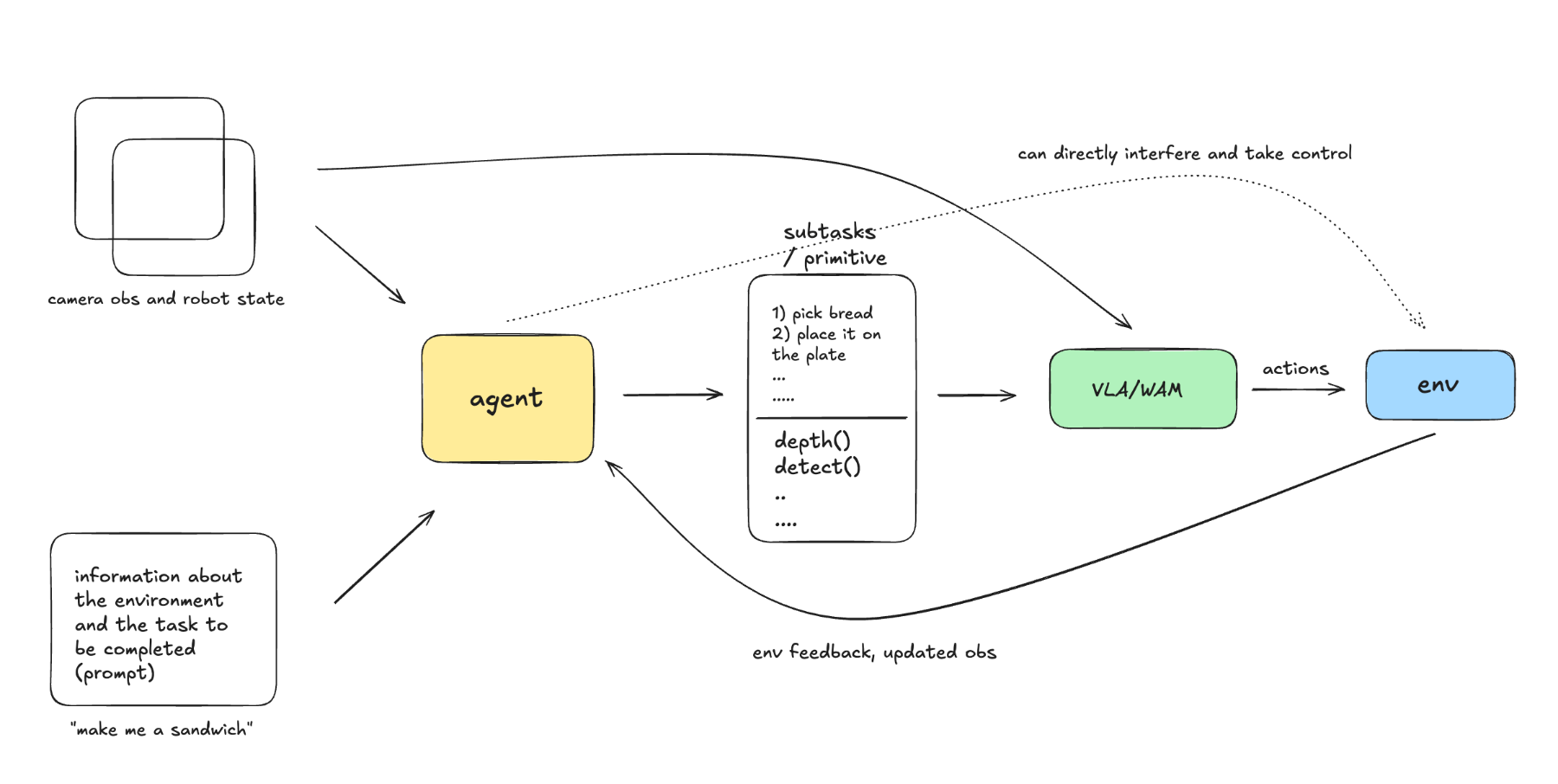
Here, the agent has access to grounding models (DINO) and agent is being run at 1Hz.
What I'm noticing is that most of the research in this topic is converging towards grounded features + VLA controlled by agent which is what the above implementation mostly looks like.
Code as Policy
The Code as Policy interface lets the agent write code that will be executed on the robot.
The simplest version of this interface will be agent writing code using the existing primitives for perception and control (Code as Policies, RoboCodeX). But this is bottlenecked by the primitives that are written by us. The agent will be able to use only the capabilities provided by the primitives and will be forced to try to complete the task using them. There's also no way for the agent to recover from a condition if it's just not able to figure out the solution, so it depends on the intelligence of the agent as well.
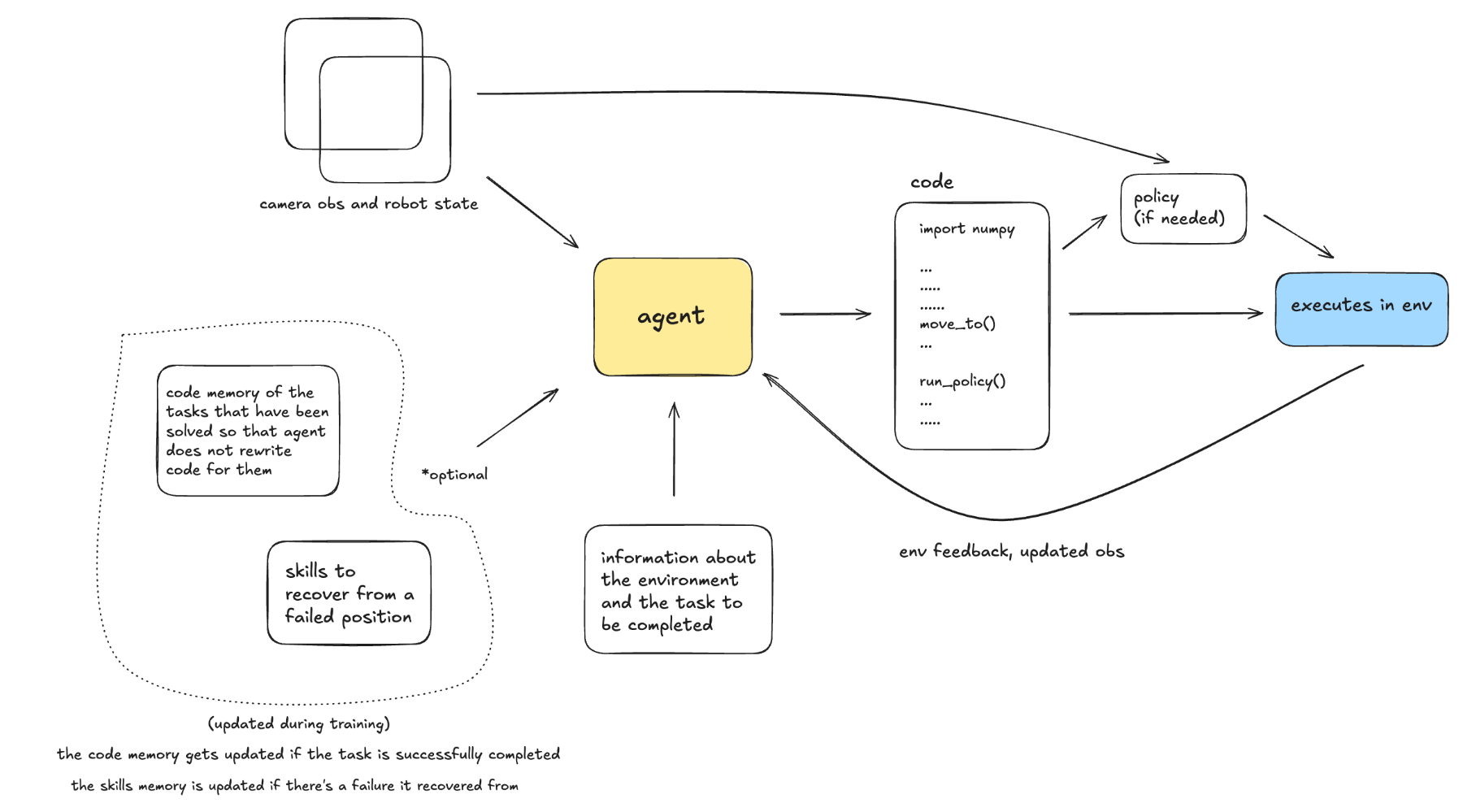
A solution to this limitation is adding skill memories (ASPIRE, RATs). Skills are memories that can be referenced by the agent when it wants to recover from a failure. These memories are created where a fix was validated in re-runs. This increases the chances of the agent successfully recovering from a failure.
To make it efficient, we can maintain code memories (RATs) which store the logic and the primitives used to complete a particular task so that when the agent encounters the same/similar task in the future, it can take that as the reference and code correctly in few or one attempt.
But after all these additions, the agent might still fail at contact-rich tasks. In contact-rich tasks, agent has very few ways to figure if it is manipulating correctly, whereas, VLA/WAM models are trained on contact-rich data which make them the strong candidate for these type of tasks. So, we can add a policy primitive which the agent can call in the code (HarnessPAI). This helps in taking advantage of agent's long horizon planning and semantic understanding along with model's contact-rich manipulation experience.
The agent can fix the environment and work on tasks which are not in the training distribution of the model. The data collected through this can be used to fine tune the model on tasks or scenes it has never encountered and is proven to make them better (HarnessPAI)!
Code as Policy Ablation (Haiku)
| task | code only (≈ CaP-Agent0) | + memory (≈ RATs) | + policy (≈ HarnessPAI's policy primitive) | + memory + policy (≈ HarnessPAI) |
|---|---|---|---|---|
| lift a cube | 5/5 | 5/5 | 5/5 | 5/5 |
| pick and place 2 cubes | 5/5 | 5/5 | 3/5 | 5/5 |
| LIBERO: open the drawer | 0/3 | 2/3 | 2/3 | 2/3 |
| LIBERO: put the bowl on the plate | 0/3 | 1/3 | 2/3 | 2/3 |
LIBERO-PRO: Objects Swapped (Haiku)
| task | smolvla alone | code + memory + policy |
|---|---|---|
| LIBERO: open the drawer | 0/3 | 1/3 |
| LIBERO: put the bowl on the plate | 0/3 | 3/3 |
This is the implementation of the interface that I think serves the best under CaP:
I believe the future interface for using robotics with agents will be something like:
System 2:
Agents: Responsible for long horizon planning, creating sub tasks, sometimes control via code
System 1:
VLA/WAM: Model trained on diverse and contact-rich manipulation data which completes the sub tasks given by the agents (system 2)
This seems to be embodiment agnostic as well!